
If you’ve been on X or GitHub this week, you’ve likely seen the flood of memes and jaw-dropping demos tagged #NanoBananaPro. What started as a quirky internal codename (and later a viral nickname) for Google’s Gemini 3 Pro Image model has effectively become the industry standard for next-gen generative AI.
But beyond the memes, what does this tool actually do for software engineers, product designers, and technical writers? The answer lies in three breakthrough capabilities: true text rendering, reasoned data visualization, and perfect character consistency.
Here are the top use cases for Nano Banana Pro that are changing the workflow at software companies right now.
1. Zero-Hallucination UI/UX Prototyping
For years, using AI to generate UI mockups resulted in “Lorem Ipsum” gibberish or alien hieroglyphics where buttons should be. Nano Banana Pro solves this with its “Text-First” rendering engine.
The Use Case: A frontend developer needs to visualize a dashboard for a FinTech app before writing a single line of React code.
The Nano Banana Advantage: You can prompt: “Create a high-fidelity mobile banking dashboard. The header should say ‘VenkatBank’, the balance shows ‘$14,250.00’, and the bottom button reads ‘Transfer Funds’ in Open Sans font.”
Result: The model generates a pixel-perfect mockup with legible, correct text. No more Photoshop patching required. This allows for rapid A/B testing of copy and layout simultaneously.
2. Dynamic “Live-Data” Infographics
This is perhaps the most “Pro” feature of the model. Because Nano Banana Pro is grounded in Gemini 3’s reasoning capabilities and connected to Google Search, it doesn’t just draw pretty pictures; it draws facts.
The Use Case: A technical writer needs to create an architectural diagram or a market trend chart for a whitepaper.
The Workflow:
- Prompt: “Search for the last 5 years of Python vs. Rust popularity on Stack Overflow and generate a line graph visualizing the trend. Label the axes correctly.”
- The Result: The model retrieves real-time data and renders an accurate chart. It understands the relationships between data points, meaning the bars or lines are proportionally correct, not just artistic interpretations.
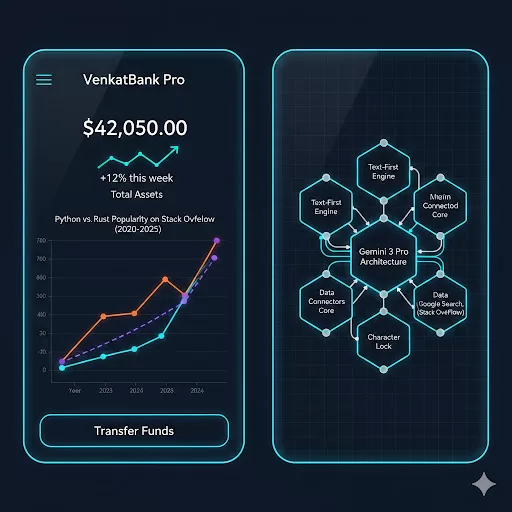
Image 1: A dual image. On the left, a mobile banking app screen titled “VenkatBank Pro” showing “$42,050.00” and “+12% this week”. Below it is a line graph titled “Python vs. Rust Popularity on Stack Overflow (2020-2025)” with labeled axes and data points. On the right, a glowing blue hexagonal flow chart titled “Gemini 3 Pro Architecture” with interconnected nodes like “Text-First Engine,” “Data Connectors Core,” and “Character Lock,” all against a dark grid background.
3. Asset Consistency for Game Devs
One of the Holy Grails of generative AI has been Character Consistency. Previous models would morph a character’s face or clothing if you asked for a different pose.
The Use Case: Indie game developers creating 2D assets or sprite sheets.
The Nano Banana Advantage: You can upload a reference image of your character (let’s say, “Cyberpunk Samurai”) and prompt: “Generate a sprite sheet of this exact character running, jumping, and attacking, side-view, 16-bit pixel art style.”
Why it works: Nano Banana Pro supports up to 14 reference images and can “lock” the identity of up to 5 distinct characters in a single scene. This ensures your samurai doesn’t suddenly change armor color in the “jump” frame.
4. Instant Localization for Global Marketing
For software teams shipping global products, asset localization is a bottleneck. You usually need a designer to manually replace text in banners for every supported language.
The Use Case: Generating App Store screenshots for Japan, Germany, and Brazil.
The Workflow: You feed the model your English marketing banner.
- Prompt: “Translate the text in this image to Japanese, maintaining the exact same font style, color, and glow effect.”
- Result: The AI rewrites the pixels of the text itself, handling complex scripts (like Kanji) without breaking the visual aesthetic. It essentially acts as a translator and graphic designer in one.
5. The “Reasoning” Storyboard
Because Nano Banana Pro runs on the Gemini 3 architecture, it possesses “spatial reasoning.” It understands physics, lighting, and 3D space better than its predecessors.
The Use Case: Directors or Lead Devs explaining a complex user flow or cinematic cutscene.
The Advantage: You can ask for complex, multi-stage interactions. “Show a split-screen storyboard where the user clicks a button on the left, and a server rack lights up on the right. Maintain lighting consistency between the two environments.” The model understands the cause-and-effect relationship requested.
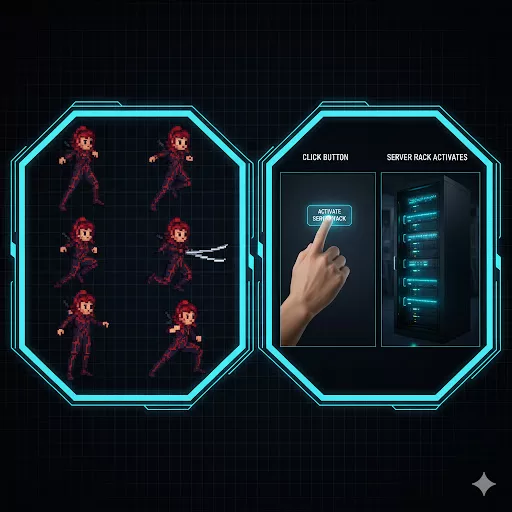
Image 2: A dual image, framed with glowing blue hexagonal borders against a dark, futuristic grid background. The left hexagon contains a 6-frame pixel art sprite sheet of a consistent character (a female ninja/samurai) in various action poses (idle, running, jumping, attacking). The right hexagon is split into two panels: the left panel shows a hand pressing a glowing button labeled “ACTIVATE SERVER RACK”, and the right panel shows a server rack inside a data center, with lights indicating activation.
How to Access It
For developers looking to integrate these features:
- Web: Available via the Gemini Advanced interface (look for the “Thinking” model toggle).
- API: Accessible via Google AI Studio under the
gemini-3-pro-imageendpoint. - Pricing: While the “Nano” name implies smallness, the “Pro” performance comes with a cost—it is more token-intensive than the standard Flash models, so optimize your prompts accordingly!
Summary
“Nano Banana Pro” might sound like a meme, but it represents the maturation of generative AI from a toy into a tool. By solving the text and consistency problems, it finally allows developers to use AI for production assets rather than just inspiration.
Venkat